
You're scrolling past a pastel bear on your phone, and the question is the same one buyers ask me all the time: does it only look cute, or does it feel worth buying? That's the right question. A good squishy animal should earn its place in your hand, on your desk, or in a gift bag, and the only way to know that is to look past the trend thumbnail and pay attention to texture, size, age fit, and the job you want it to do.
Cute squishy animals have had the perfect runway online because people already love animal content in short-form feeds. A 2024 survey found that 98.5% of social-media users had watched an animal video, and 41.8% of those videos were funny or entertaining (survey summary in the study). That doesn't mean every animal-shaped toy is worth buying, but it does explain why these pieces keep showing up in carts, gifts, and desk setups. If you're a trend follower, a parent, a gift shopper, or someone who just wants a better fidget, this guide cuts through the hype fast.
Table of Contents
- Why Everyone Is Squeezing Cute Animal Squishies Right Now
- What Counts as a Cute Squishy Animal
- Why Animal Shapes Travel So Well Online
- Textures That Decide Whether You Will Actually Squeeze It
- Popular Picks and Who They Are Really For
- Do Cute Animal Squishies Actually Help With Stress or Focus
- A Quick Safety and Care Checklist Before You Click Buy
- Choosing Your First Cute Animal Squishy With Confidence
Why Everyone Is Squeezing Cute Animal Squishies Right Now
People react fast to animal imagery, and they keep reacting to it across platforms. In a sample of 162 animal videos, researchers found 113 on TikTok, 20 on Instagram, and 29 on YouTube. The same study showed dogs made up 67.3% of the sample and cats 32.7%, with Pomeranians, pugs, and English bulldogs leading the dog group (platform study). That is why recognizable animal shapes spread so well. People read them in a split second, and that instant recognition helps a squishy get clicked, shared, and remembered.
What that means for buyers
Shop with your eyes first. Pick designs that read clearly on camera and in the hand. Those are the ones that keep moving through gifts, desk setups, and impulse buys.
A toy that looks expressive from three feet away usually beats a design that depends on tiny details nobody notices. If the shape is obvious at a glance, it has a better shot at lasting past the first trend wave.
Wildlife imagery does not stop at the usual furry favorites. Frogs, sea creatures, and oddball hybrids can work just as well, which is why a mixed lineup makes sense, JCR article. Archie's Squishies follows that logic with familiar faces and weird little surprises in the same catalog.
What buyers should care about most is whether the piece still makes sense after the feed stops moving. Cute helps it get noticed. Clear shape, satisfying feel, and the right size are what make it worth keeping.
What Counts as a Cute Squishy Animal
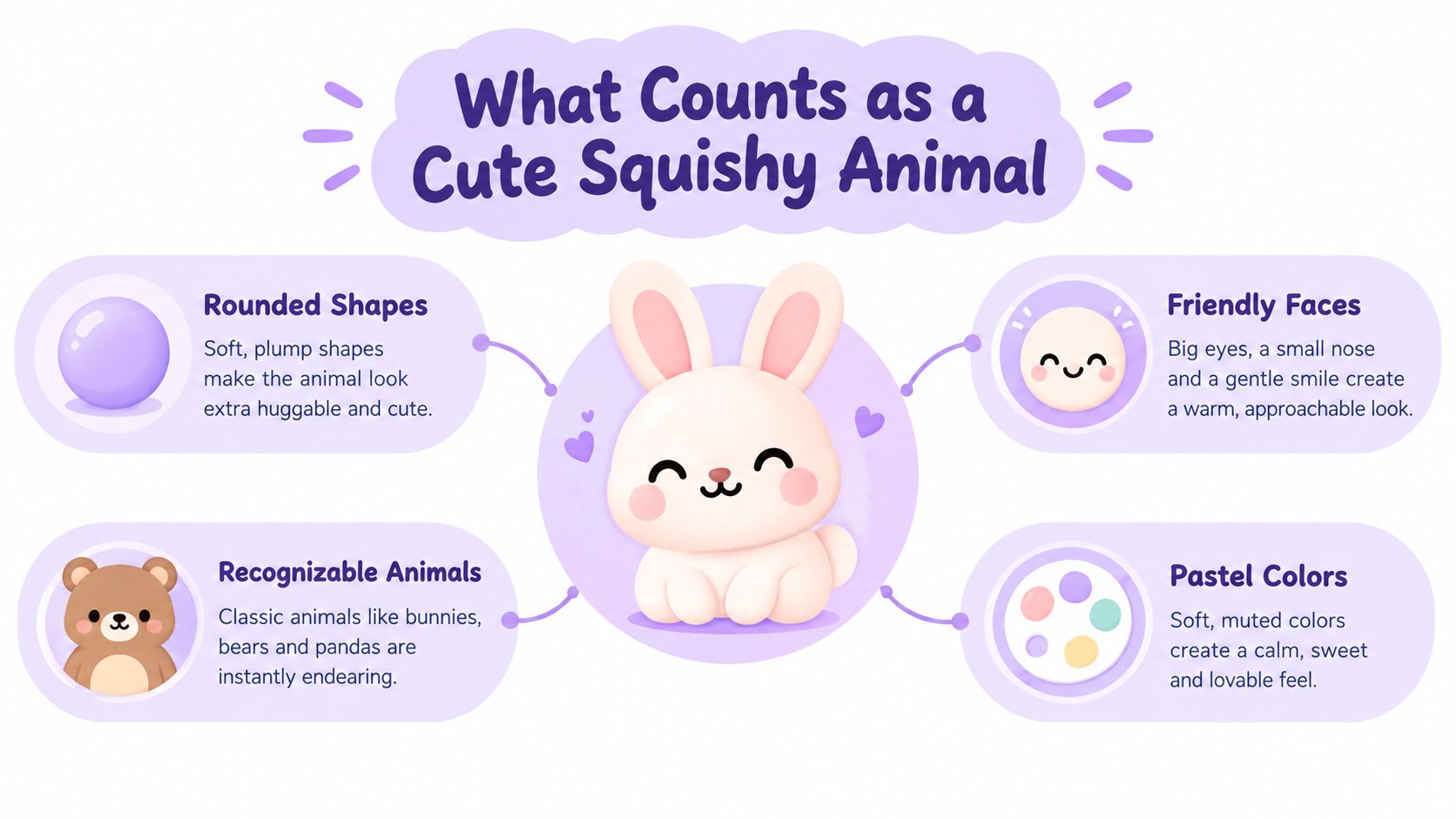
A cute squishy animal is really two things at once, a visual design and a feel. The visual side leans on rounded shapes, friendly faces, and species people recognize right away. The feel side is about recovery, resistance, and how satisfying the squeeze is when your hand closes around it. If one of those parts is missing, the toy can still be fun, but it won't hold attention for long.
The shapes that feel right
Rounded bodies matter because they give the eye a soft landing. Friendly faces matter because they turn a blob into a character. Pastel or candy-bright colors work because they make the object feel playful before you even touch it. The result is a toy that reads as cute from a distance and pleasing up close.
Not every animal squishy has to be a cat or dog. The category also includes sea creatures, woodland animals, and hybrids that borrow from food or fantasy, and those weird little designs often become collector favorites because they stand out in a shelf photo. A product like Golden Cheese Squishy fits that logic neatly, since it uses a novelty shape and still keeps the soft, moldable feel that makes the category work.
Shape is not the same as feel
Don't let the design trick you into buying the wrong texture. A slow-rise bear, a glossy charm, and a plush-looking duck can all feel completely different in the hand. That's why browsing by animal alone isn't enough. You want to know whether the piece is meant to compress slowly, spring back quickly, or sit mostly as a display object until you reach for it.
Shop-floor truth: cute gets the click, but texture decides whether the toy lives on your desk or ends up in a drawer.
Why Animal Shapes Travel So Well Online
Animal shapes are easy to understand, easy to film, and easy to remember. That is why they spread faster than many abstract squishy designs. A viewer does not need a caption to know what a cat, bear, rabbit, or baby chick is supposed to be doing, and that matters in short-form video where attention is brief.
Presentation beats species purity. Less conventional animals can be just as engaging, so a frog, octopus, dumpling, or other oddball character deserves a place in a small collection if the shape reads clearly and the face has personality.
What that means in a catalog
For a buyer, the online effect turns into three practical choices:
- Pick recognizable silhouettes. A clear animal profile photographs better and reads faster in a gift feed.
- Keep one oddball in the mix. Novel shapes often become the item people remember.
- Do not chase only cats and dogs. Broader themes make a collection feel more thoughtful and less repetitive.
If you want to see how a larger, playful shape gets positioned for visual impact, the Jumbo Peach Squishy page is a useful example of how big, simple forms can still carry the same social-first appeal.
The same logic explains why limited or seasonal animal drops do so well. People buy them because they feel like a moment, not just a toy. A cute animal squishy with a clear silhouette and a strong theme is easier to recommend, easier to gift, and easier to keep reaching for after the novelty fades.
Textures That Decide Whether You Will Actually Squeeze It
A lot of buyers make the mistake of shopping by color first. That's backwards. Texture is what determines whether you'll keep squeezing the piece, hand it to a kid, leave it on a desk, or forget it exists after the first day.
Match the feel to the job
Slow-rise is the safest pick for most adults. It gives you that long, sinking squeeze and a gentler rebound, which makes it good for quiet desk use and steady handling. If you want something that feels calm rather than snappy, start there.
Fast rebound works better for people who want quicker feedback. It feels more active in the hand and can be more playful than restful. Kids often like that, because the return gives them an immediate response.
Buttery and crunchy textures are the ones people either love instantly or bounce off right away. Buttery feels smoother and softer under the fingers, while crunchy adds more sensory variation. If you enjoy a little sound or surface change, those are the textures to try. If you need quiet, skip them.
Squeezy styles are usually the most straightforward. They're easy to understand, easy to hand off, and easy to use without explanation. That makes them useful for younger buyers or anyone who wants a no-fuss toy.
Coconut oil style pieces tend to sit in a novelty lane. The feel is part of the appeal, but the look matters too. Those are often the items people choose because they want something a bit different, not because they need the softest possible squeeze.
A good texture should answer one question fast, “Do I want to keep touching this?”
If you're comparing a handful of options, look at one plain rule: the more time you expect to spend holding the toy, the more you should favor a slower, less distracting texture. Archie's Squishies has a slow-rising foam guide that matches this buying logic well, because texture and use-case should always be matched before you buy.
Popular Picks and Who They Are Really For
Gift buyers should think differently from collectors, and collectors should think differently from desk users. A single “best” squishy doesn't exist. The right one depends on whether you're buying to hand it over, keep it on display, or squeeze it all afternoon.
For gifts
Surprise-style pieces do the least work for the buyer and often do the most work for the recipient. A mystery dumpling, a novelty animal, or a small character with a friendly face gives you that instant unwrapping reaction without needing a deep background story. That's why playful shapes and compact sizes usually win here.
For desks and fidgeting
Small, slow-rise pieces are the better call if the toy has to live near a laptop, notebook, or keyboard. A hand-sized animal with gentle resistance is easier to use one-handed and less likely to become a distraction. I'd choose that over a flashy piece with extra decoration every single time if focus matters.
For display and collecting
The collector lane is where weirdness helps. Unusual shapes, seasonal runs, and novelty pieces hold attention because they look different next to standard animal forms. That's also where theme variety matters most, since a shelf full of similar cats gets stale fast.
A useful way to shop is to ask which bucket the toy belongs in before you even inspect the color. If it's a gift, choose clarity and charm. If it's for your own desk, choose texture and size. If it's for collecting, choose the piece that looks distinct in a lineup.
Do Cute Animal Squishies Actually Help With Stress or Focus
A cute face doesn't make a toy therapeutic. That's the honest answer. Some people feel calmer with a squishy in hand, while others get more distracted because the toy is too fun to put down.
The evidence is mixed but not useless. One small classroom study found that introducing hand and foot fidgets improved focused instructional attention, and removing them reduced performance (fidget study). A later review was more cautious, saying the broader evidence for classroom attention and learning is still limited, and some studies report distraction instead of benefit (review). That's the right way to think about squishies. They may help in some situations, but they're not magic.

Use a simple test
Before you decide a squishy “helps,” ask yourself three things:
- Does it calm me down?
- Does it pull my attention away from work?
- Do I keep playing with it instead of using it as a quiet hand tool?
If the answer to the second or third question is yes, choose a lower-visual-distraction design and a simpler texture. That's the smart move for study tables and office desks. A cute animal shape is fine, but it shouldn't become the main event.
If you want a deeper look at the user side of tactile toys, Archie's Squishies has a sensory squishy benefits guide that fits this evidence-aware view. I'd still keep the expectation modest, though. Buy squishies for enjoyment and tactile engagement first, not as a treatment.
A Quick Safety and Care Checklist Before You Click Buy
Safety starts before the package arrives. If the listing is vague, skip it. If the toy is meant for a child, the age guidance should be clear, and the size should make sense for that age and for the way the toy will be used.
For children's toys in the United States, accessible plasticized parts must stay within the 0.1% (1,000 ppm) phthalate limit under the Consumer Product Safety Improvement Act and CPSC rules (CPSC guidance). That matters for soft, squeezable toys because the material itself is part of the safety picture. Don't rely on a vague “safe” label alone. Ask for material declarations and finished-product test reports when the product is for a child.
Check the toy when it arrives
- Look for tears or seams: Any split in the outer layer can turn a cute piece into a mess.
- Check for loose decorations: Small parts are a bad fit for younger children.
- Watch for exposed filling: If the inside is showing, stop using it.
- Notice strong scents or sticky surfaces: Those are signs to inspect more carefully.
- Wash and store it properly: Squishies get handled, packed, and passed around, so keep them clean and dry.
Pediatric and classroom commentary both point to the same basic point, softness doesn't cancel out risk. Small parts can still be choking hazards, and a toy that gets tossed in a bag every day needs more care than a shelf ornament (safety review). If you're buying for a child, supervision matters more than marketing language.
For a quick size-and-age reference, Archie's Squishies has a mochi stuffed toy guide and a squishy age recommendations page. Those two checks, size and age, solve half of the problems before the package is even opened.
Choosing Your First Cute Animal Squishy With Confidence
Start with the purpose, then pick the texture, then match the size. That order saves money and cuts regret. A desk piece should feel different from a gift, and a gift should feel different from a collector item. Once you sort that out, the cute part becomes the fun part instead of the trap.
If you only remember one rule, make it this. Cute is the filter, not the decision. The decision is whether the piece fits the hand, the age, and the setting you have in mind.
When I help buyers choose, I look for three things fast. The shape should be readable, the texture should match the use, and the listing should give enough safety information to make the purchase feel clean. That's how you avoid the random buy that sits untouched while the one great piece gets squeezed every day.
Archie's Squishies curates tactile toys that line up with social-media trends, from animal shapes to novelty textures and surprise-style picks. If you want a cute squishy animal that's chosen with feel, size, and safety in mind, visit Archie's Squishies and browse the pieces that match your intended use.
Prepared with Outrank tool